
- 25.10.2017
- Розділ Інформаційні статті
- 5385
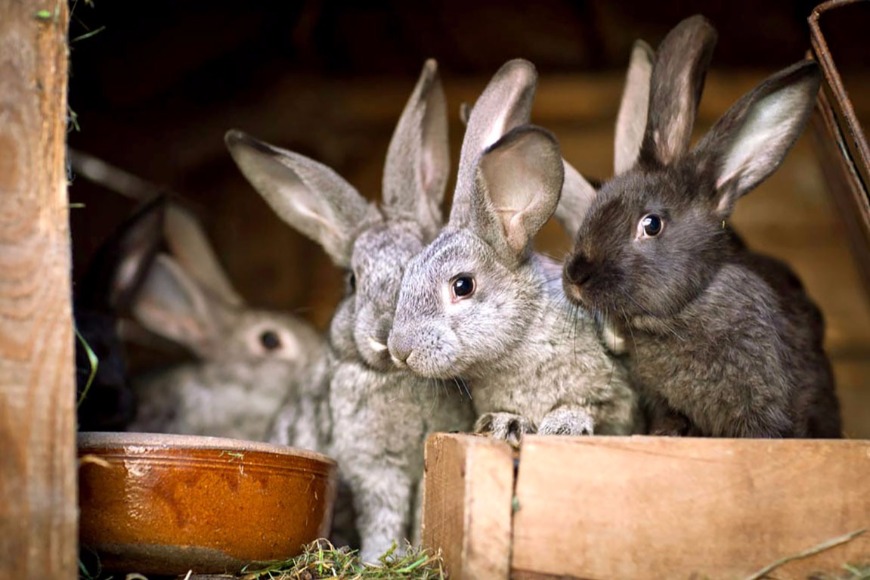
Literary sources, the practice of growing and feeding rabbits includes many publications, experience of both domestic and foreign technologies. Specialists and amateurs unite in associations, clubs. On the forums of rabbit breeders, you can often find interesting ideas, projects, and news about keeping, breed characteristics, veterinary care, and livestock feeding..
Today, royalism is represented by a number of technologies, the main of which are retro-technology, techno-royalty and eco-royalty.
Retro-technology is based on traditional methods of farming, which are used for a small peasant farm with up to 50 rabbits. With this technology, the simplest methods of keeping rabbits are used, the ration is based on the available fodder base of the peasant farm, and the rabbits are not protected from outbreaks of various viral infections. Also, the breeding of rabbits is affected by the seasonal factor, and the age of reaching marketable weight can be 150-160 days.
Techno-rabbit farming involves modern keeping and breeding of rabbits on an industrial scale. Rabbits grown using this technology are very different in meat quality, as they are fattened using various drugs that accelerate growth. Techno-rabbit breeding is a stable and profitable business, if its scale is large, from 2 to 10 thousand rabbits, and this, accordingly, requires a large starting capital from 1.5 to 5.0 million euros. The payback of such a rabbitry can last more than 10 years.
Eco-rabbit farming is rabbit farming that uses technologies of keeping, breeding and feeding as close as possible to natural ones. This technology aims to obtain products of the highest consumer quality without using feed containing growth stimulants. At the same time, the reproductive qualities of animals are always the best. With this technology of growing rabbits, in addition to meat, fur has a commercial value. When slaughtered in 120-130 days, the carcass weighs 2.0-2.3 kg.
The technology of raising young animals for meat is based on the biological feature of rabbits — high growth energy and feed payment in the first months of life. Depending on the period of weaning of rabbits, two methods of raising young animals for meat are used in practice: intensive and broiler.
The intensive method is based on the biological feature of female rabbits to combine lactation and fertility. That is, rabbits are weaned at 30 days, and female rabbits are mated on the 25th day of lactation. With this method of breeding, you can get 32-36 rabbits per year from a mother rabbit, or up to 100 kg of meat in live weight.
Another variant of the intensive breeding method involves weaning the rabbits at the age of 45 days and mating the female rabbits on the 30th day of lactation. With this method, you can grow up to 30 rabbits and get about 80 kg of meat in live weight from a female. Using an intensive method of growing young, a mother rabbit produces six litters per year, and the rabbits are grown up to 90 days of age and sold with a live weight of 2.5-3 kilograms.
The broiler breeding method involves weaning rabbits at the age of 60-65 days and selling them for meat when they reach a live weight of 1.8-2 kilograms. Mating of female rabbits is carried out a few days before weaning or on the day of weaning, which allows you to get four litters from them in a year and raise up to 25 rabbits with a total live weight of 35-45 kg. This method has a number of advantages, although it is inferior to the volume of meat production per female rabbit. Feed consumption during broiler breeding of rabbits is 2.8-3 fodder units, and when reared up to 90 days of age – 4.5-5 fodder units. Extending the duration of the suckling period to 60-65 days in broiler breeding creates favorable conditions for the growth and development of rabbits, significantly reduces the number of gastrointestinal diseases, increases viability and reduces the drop of young.
And now I want to stop on feeding, because this part makes up more than 60% of the productive potential, and is controversial for many experts in the field.
In order to carry out intensive breeding of young rabbits, in addition to veterinary and zoohygienic methods, it is necessary to provide animals with high-quality feed. This is problematic since the fodder that enters the animal feeder goes a long way (collection, storage, processing) during which various harmful factors may affect them.
And if the quality of grain feed and products of their processing can be assessed organoleptically (taste, smell, appearance) by an average owner, it is difficult to make such an assessment in the composition of ready-made compound feed. This is due to the fact that low-quality grain fodder or other components of complete combined feed are masked by a complex of flavor and aroma additives that do not distinguish their low quality. By using such compound feed in feeding rabbits, rabbit farmers not only do not get the desired result, but they can also lose part of the stock, especially the rabbits that are under the mother rabbit and the weaned young.
Such cases are not isolated when animals died due to low-quality compound feed, and it is almost impossible to prove it, as evidenced by the communication of rabbit breeders on forums of Internet sources..
The majority of farmers and ordinary owners are returning to the use of feed of their own production with minimal purchase of feed means. Some owners completely refuse to use chemical preparations and foreign feed products, which, after the introduction of a ban on the use of some of their components in the European Union, filled our market and are even produced in our country using our imperfect legislation.
The refusal to use artificially created synthetic drugs in animal feed is connected with the transition of households and individual peasant farms to the production of ecologically clean products. This is the way Europe is going, and Ukraine, as a large agrarian state, must listen and respond to the events taking place in the agricultural market of the European Union.
Therefore, the use of natural feed in feeding for the purpose of obtaining ecologically clean and safe food products is very relevant.
Using our own research and the results obtained in production, various types of rabbit feeding were analyzed and their characteristics and evaluation were made (Table 1).
Table 1
Comparative assessment of different types of rabbit feeding in commercial rabbit farms
| Rough feed | Grain part | Benefits | Disadvantages |
| Grass (hay) + root vegetables | Whole grain | Feeding close to natural conditions. The high cost of selling eco-products. | Lack of micro- and macroelements, low live weight gains |
| Grass (hay) + root vegetables | Grits (feed mixture) grain + legumes + protein part + macroelements | Higher live weight gains | Physiological inability to consume loose fodder mixtures. High losses of final feed (overturning from feeders) |
| Grass (hay) + root vegetables | Steamed gruel (feed mixture) grain + legumes + protein part + macro- and microelements, vitamins | High gains in live weight. High level of assimilation of final feed. | There is a high probability of digestive disorders. Storage limitations. High labor costs for feed preparation. Denaturation of nutrients during heat treatment. |
| grass (hay) | Combined feed | High gains in live weight. High level of assimilation of final feed. Reduction of labor costs | Increase in the value of livestock live weight gain. Incompatibility of the physiological needs of animals with quality indicators of compound feed. |
| Specialized compound feed for rabbits | High gains in live weight, low level of feed consumption. Low labor cost | High cost of live weight gain. Not using one’s own fodder production potential. The intensive method of maintenance does not take into account the peculiarities of the natural physiology of animals. Death of animals due to the use of low-quality feed | |
| Grass (hay) + root vegetables | Whole cereal grain + AAVMFC “ZHYVYNA” (animal) granules. | Feeding close to natural conditions (eco-products). High live weight gains. High level of assimilation of final feed (free feeding). Effective use of own feed production potential. Reduction of labor costs. Low cost per unit of live weight gain. |
Unlike similar manufacturers, the form of release of feed concentrate “ZHYVYNA” is granulometric, each pellet contains the most necessary set of scarce feed components, preventing their loss and stratification. This makes the product particularly acceptable and effective for rabbits. From practical experience regarding the uniformity of mixing AAVMFC “ZHYVYNA” with concentrated feed, it can be concluded that group animals consume the product from feeders through free access and evenly without overeating by individual individuals. A slight excess of consumption of the recommended rate of concentrate on one day is compensated by a decrease in the need on the next. There is a phenomenon of self-regulation of the process of feeding group animals. If there is a sufficient fodder base (rough, juicy, fodder.
The environmental friendliness and naturalness of the feeding of farm animals, and therefore the corresponding quality of commercial products, have recently increasingly become a significant factor in the consumer attitudes of the population. Taking into account that the price of selling natural ecological products, other things being equal, is almost twice as high as similar products produced in intensive conditions, you can choose the right direction for feeding your own rabbit population. The authority of such eco-farms is getting stronger, and the very approaches to management are gaining momentum, despite some difficulties (certification, sales markets, market fluctuations, etc.).
The time of gigantomania and intensive methods of production of livestock and poultry products was experienced by the Ukrainian village in the recent 70-80s. Known to science, the effect of scale, with a significant concentration of biological resources in one place, led, leads and will lead to outbreaks of epizootics, ecological disasters and other global problems. The desire to resuscitate or import from abroad the technologies of large-scale animal husbandry complexes on the part of latifundists-animal husbandry, owners of complexes (who use only the eco-products of DELISHES eco-farms for their own consumption) encounters the understandable natural resistance of a large part of both the urban and rural population, private producers, farmers, collective farms. The threat of displacement of small agricultural forms in the village and the village itself is becoming stronger every year, gaining momentum. In such an unequal confrontation, only the combined efforts of private producers, veterinarians, zootechnical specialists, and science will allow us to maintain our positions and defend our own market position. Only development and improvement can be predicted for the royal industry in such a union.
O. Kylymnyuk
Ph.D. Institute of Fodder and Agriculture Polissia of the National Academy of Agrarian Sciences of Ukraine


